
Section 1 – Demystifying
Agentic AI is not a tool. It’s a strategic decision.
Agentic AI is generating unprecedented enthusiasm when compared to the first waves of cloud or digital transformation. The demonstrations are impressive. Promises abound. Prototypes are multiplying.
But one question is rarely asked: what will agentique really change in your organization?
An AI agent is neither an enhanced chatbot, nor a simple extension of ChatGPT, Claude or Gemini. It’s a system capable of understanding a situation, making a decision and acting within your systems to achieve an operational goal.
This change is profound. It does not begin with a technological choice. It begins with strategic questions:
- What processes are we going to change?
- What level of autonomy is acceptable?
- Who will be responsible for automated decisions?
Agentique is not an experiment. It’s an organizational amplifier.
It makes good choices more powerful. And the wrong ones much more costly.
In this article
A profound change in the way we work
A word of clarification: AI agents are neither a gadget nor an improved extension of ChatGPT, Claude or Gemini.
They represent a much more profound change in the way work is performed within organizations. This change is not primarily a technological problem. It poses a problem of structure, priorities and execution discipline.

First, a few definitions.
Generative AI
Generative AI
Artificial intelligence system capable of producing new content (text, image, code, audio) from human instructions (queries or prompts).

ChatGPT, Claude, Copilot or Gemini are generative AI systems. They help to think, create and analyze, but do not execute actions in the systems.
An AI agent
Agent IA
An AI agent is a system capable of understanding a situation, making a decision and acting in a system to achieve a goal.
Unlike a generative AI system, it doesn’t just respond. It can access data, use tools and trigger actions.
Although generative AI and AI agents share the same foundations, namely large language models (LLMs), their usage differs profoundly. Generative AI uses these models to produce an answer to a question. An AI agent, on the other hand, uses them to achieve a goal: it establishes a plan, executes the necessary actions and adjusts its behavior iteratively.
Simply put, an agent must integrate three key capabilities:
- Autonomy to decide: determine the actions to be taken to achieve a given objective.
- Access to tools and data: use the resources needed to carry out these actions in real systems.
- Self-evaluation of results: evaluate the results obtained and iterate until you consider that the objective has been achieved.
Askill
Skill
A reusable procedure for performing a specific type of task. Smaller than an agent and more durable than a prompt.
Before we can understand agentic systems, we need to understand the notion of skill.
A skill is a reusable procedure for performing a specific type of task. It can be seen as a specialized functional block that an agent can call up when needed.
For example:
- write a customer brief before a meeting
- retrieve an order from an ERP system
- generate a sales proposal
- respond to a ticket in a support system
A skill is smaller than an agent.
An agent can use several skills to achieve a goal, whereas a skill generally performs one action or a limited sequence of actions.
Competencies are the building blocks that enable agents to work reliably, consistently and reusably across the organization.
MCP (Model Context Protocol)
MCP (Model Context Protocol)
Standardized protocol that enables an artificial intelligence model to connect to external systems in a structured and secure way.
For an agent to really work, it must be able to access the organization’s tools, data and systems. This is precisely the role of the MCP(Model Context Protocol).
It can be seen as the equivalent of an API for AI. The MCP enables different AI models to connect to different enterprise systems without having to recreate a specific integration each time.
For example, an MCP server can expose :
- CRM
- ERP
- a knowledge base
- a ticketing system
- a data warehouse
- financial software
- an HR platform
The agent doesn’t need to know the technical details of each of these systems. He simply uses the tools and information made available to him by the MCP.
Why is this important?
Without a standardized mechanism for accessing data and tools, each agent becomes a unique integration project. The organization then finds itself having to multiply custom developments, which increases costs, slows deployment and complicates maintenance.
Instead, MCP creates a reusable connectivity layer between agents and enterprise systems.
This approach offers several advantages:
- accelerated deployment of new agents
- reuse of existing integrations
- better access governance
- reducing technical complexity
- greater independence from AI model suppliers
MCP is not an agent
A common misconception is that PCM is a form of artificial intelligence. It is not. The MCP does not reason. The PCM does not make decisions.
The MCP simply acts as a connectivity layer that enables agents andskills to access the systems they need to get the job done.
TL;DR definitions
In simple terms :
- The LLM thinks and plans.
- The skill executes a specialized capability.
- The agent coordinates actions to achieve an objective.
- The MCP provides access to tools, data and systems.
- The agentic system orchestrates the whole to create enterprise-wide value.
This distinction is important, because most organizations don’t need hundreds of agents. What they do need is a solid connectivity foundation that will enable their future agents to work effectively in their technological environment.
So what does an agentic platform really look like?
Agentic platform
A set of agents, rules, skills and integrations that work together to execute a real process. The agentic platform is what creates value at scale, because it coordinates decisions, data and actions.
When we talk about AI agents, many people imagine an autonomous assistant capable of doing everything. The reality is different.
In organizations deploying agentiics on a large scale, agents don’t work alone. They rely on a platform that connects users, enterprise systems, data and specialized skills.
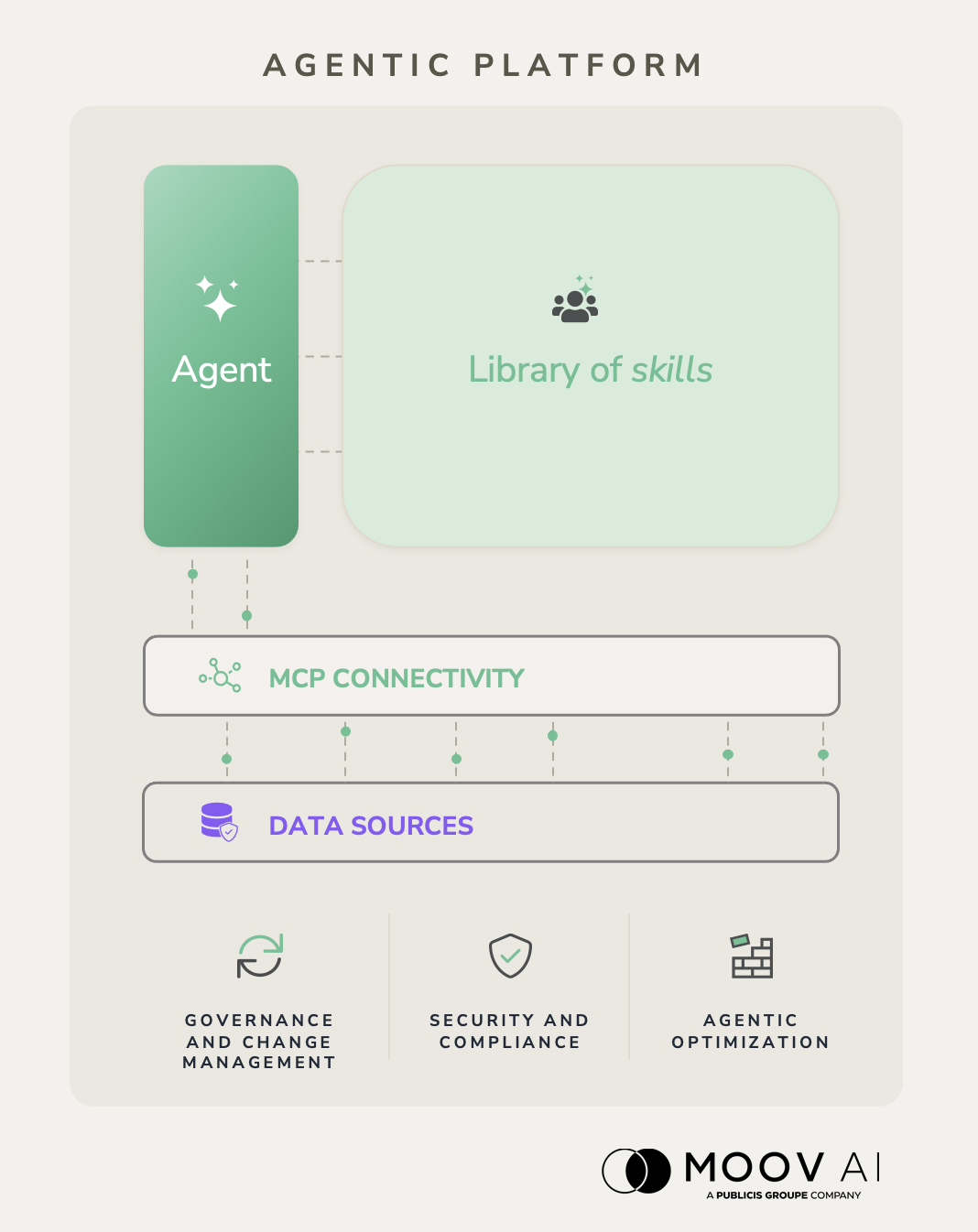
In this architecture :
- users interact with one or more agents;
- agents use specialized skills (via a shared skills library );
- skills access corporate systems (CRM, ERP, documentation, BI, etc.);
- systems connect to different data sources;
- governance, security, compliance and change management.
Value does not come from an isolated agent.
It comes from the organization’s ability to orchestrate multiple skills, multiple systems and multiple data sources around common business objectives.
The most common mistake: confusing individual productivity with operational transformation
In most organizations, the first discussions about AI agents start in the wrong place:
- The teams talk about tools.
- Employees talk about personal gain.
- Management talks about innovation.
As a result, everyone projects their expectations onto the agentic, without aligning themselves.
An AI system that helps an employee write an e-mail faster or summarize a document can be useful. But this type of gain, taken in isolation, does not transform an organization. Micro-automations give the impression that the organization is making progress, whereas they mainly improve the individual experience without changing collective performance. Efforts do not materialize into concrete benefits. Transformation begins when agents change the way processes work, not just the speed at which an individual completes a task.
The signals are attractive:
- “We save time
- “Faster responses
- “Teams love the tool
But these signals say nothing about the real impact. A gain becomes an organizational lever only if it reduces systemic friction, decreases process variability, eliminates a bottleneck or frees up time where it was structurally constrained.
Without this, agenticity acts as a gas pedal of activity (or chaos), not as an engine of transformation. This is how organizations accumulate agents that are useful individually, but incapable of producing a sustainable company-wide advantage.
What it really means to succeed with AI agents
Having an agent in production is not an indicator of impact. What counts is the orchestration of capabilities. Success is not measured by the number of agents in production, nor by the sophistication of a demonstration. Especially since, with the new generation of LLM models, a single agent can now handle many tasks (more on this later).
Success is measured by tangible business levers:
- faster turnaround on critical processes
- reduced operating costs
- improved service levels
- income generation
- risk reduction
- greater operational resilience
These levers force us to make choices. They force prioritization and prevent agentique from becoming a purely technological playground.
A successfully deployed agent modifies a process. A strategic agent improves process performance. Without clear indicators, agentique becomes a technological project rather than influencing execution capability.
The invisible but structuring benefits of agenticity
From automation to vibing
The agentic opens the door to two distinct phenomena.
The first is automation.
Organizations can transfer certain activities currently carried out by employees to agents capable of understanding a context, making decisions and executing actions across multiple systems.
Automation
Move from employees managing processes to agents managing core business activities.
The second phenomenon is what we call vibing.
Vibing is about enabling employees, even without in-depth expertise in a particular field, to rapidly produce results that previously required specialists.
Vibing
Any employee, no matter how skilled, can produce value worthy of specialists*.
Here are a few examples of vibing :
- A manager can build a complex analysis.
- A sales representative can automate a process.
- An HR specialist can develop an in-house assistant.
This democratization of production capacity is powerful. It accelerates innovation and reduces certain performance barriers.
But it also increases the need for governance.
When anyone can create, automate or rapidly deploy operational capabilities, organizations need to be even more disciplined about the data they use, the rules they apply, and the responsibilities associated with automated and non-automated decisions.
* We’ve deliberately qualified this definition. The key word here is “worthy” of specialists. Obviously, a CMO trying to vibe a financial analysis is unlikely to produce the same finesse and quality of analysis as the CFO. Vibing is therefore a double-edged sword, but it remains a reality that companies have to face.
The most important spin-offs are rarely highlighted
The most important benefits of AI agents are rarely highlighted, as they are less spectacular than the demos.
And yet they are often the ones that justify the investment:
- accelerate onboarding of new employees by capturing operational knowledge
- reduced dependence on key experts
- decision standardization in complex contexts
- simplification of operations and chains of responsibility
- better continuity despite staff turnover.
These benefits are difficult to demonstrate in a Proof of Concept (PoC). They only become obvious when agents are thought of as organizational capabilities, not as isolated assistants.
TL;DR
- – If you don’t know which business lever you want to activate, AI agents will amplify chaos, not value.
- – A skill is the basic building block of an agentic system.
- – Value rarely comes from a single agent, but rather from the orchestration of agents, skills, data and systems.
- – Before talking about tools, we need to talk about change management.
- – Agentique is not a shortcut to transformation. It’s an amplifier. And like all amplifiers, it makes good choices more powerful and bad ones much more expensive.